


People’s Republic of China


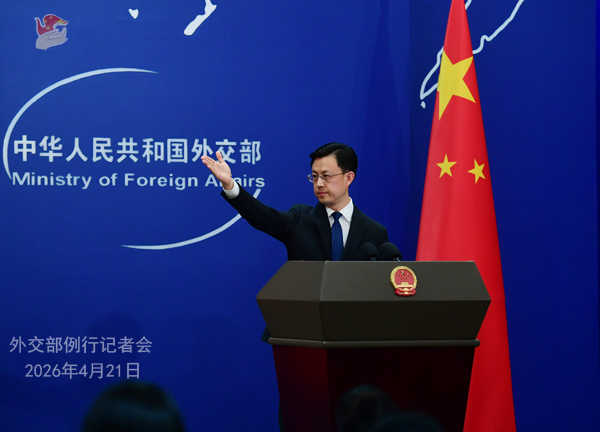
Member of the Political Bureau of the CPC Central Committee and Minister of Foreign Affairs Wang Yi will visit Cambodia, Thailand and Myanmar upon invitation from April 22 to 26. He will attend with Defense Minister Dong Jun the first meeting of China-Cambodia 2+2 strategic dialogue mechanism between foreign and defense ministers.
China News Service: You just announced that Foreign Minister Wang Yi will visit Cambodia, Thailand and Myanmar. Could you share with us China’s expectations on the visit?
Guo Jiakun: Cambodia, Thailand and Myanmar are China’s friends and neighbors. Under the strategic guidance of President Xi Jinping and the leaders of the three countries, sustained and steady progress has been made in building a community with a shared future between China and the three countries, injecting strong impetus into their respective national development.
The century-defining transformation is unfolding at an accelerating pace, bringing more risks and challenges to regional countries. At the same time, all the three countries are at a critical juncture for development, as Cambodia is implementing the Pentagonal Strategy at a faster pace, and the new governments of Thailand and Myanmar were formed not long ago. Therefore, through this visit, China hopes to implement the common understandings among the leaders, deepen comprehensive strategic cooperation, consolidate China-Cambodia ironclad friendship, enrich the family-like relationship between China and Thailand, carry forward the “pauk-phaw” friendship between China and Myanmar, bring more benefits to the peoples and make greater contributions to peace, stability, development and prosperity in the region.
Xinhua News Agency: Could you share the arrangements of the first meeting between foreign ministers and defense ministers of China and Cambodia under the “2+2” strategic dialogue mechanism? What topics will be covered?
Guo Jiakun: During the visit to Cambodia in April last year, President Xi Jinping and the leader of Cambodia agreed on establishing the “2+2” strategic dialogue mechanism between foreign ministers and defense ministers of the two countries. It fully demonstrates the high-level and strategic nature of the bilateral relations.
Amid turbulence and transformations in the world, the launch of the “2+2” strategic dialogue mechanism can help China and Cambodia strengthen strategic communication and tackle external challenges together. It is part of the effort to deepen China-Cambodia all-weather community with a shared future in the new era and a sure path to advance the two countries’ modernization drive. Foreign Minister Wang Yi and Defense Minister Dong Jun will have an in-depth exchange of views with the Cambodian side with a focus on bilateral relations, cooperation on political and defense security issues, and international and regional situations. They will have meetings with Cambodian leaders. China is ready to work with Cambodia to make good use of the strategic communication platform, and make coordinated efforts to advance high-quality development and high-level security for the prosperity, revitalization and long-term stability of the two countries.
Nippon TV: Today, the Japanese government has revised limits on defense equipment exports which enables the sales of weapons overseas. The government says that it will promote security cooperation with partner countries. Does China have any comment on this?
Guo Jiakun: China is gravely concerned. Japanese militarists during their aggression and expansion last century committed horrendous crimes against China and other neighboring countries in Asia. Given the history of aggression and to prevent the revival of Japanese militarism, the Cairo Declaration, the Potsdam Proclamation, the Japanese Instrument of Surrender and a series of documents with full legal effect under international law explicitly require Japan to be “completely disarmed” and not to maintain industries that “would enable her to re-arm for war.” The Japanese Constitution also contains strict restrictions on Japan’s military strength, right of belligerency and right to war. After WWII, Japan further established stringent norms such as the “exclusively defense-oriented principle” to limit the development of military strength and the export of weapons. In 1976, the Japanese government issued a unified view on arms exports demanding that Japan, “as a nation dedicated to peace,” exercise caution on arms export.
Japan’s recent dangerous moves in the military and security fields defy its self-proclaimed “dedication to peace” and adherence to the “exclusively defense-oriented” policy. Many experts and scholars expressed concern that Japan is restarting its “war machine” and “exporting wars.” Japan’s quickened remilitarization is already a reality and comes with actual roadmap and steps being taken. The international community, including China, will remain highly vigilant and firmly resist Japan’s reckless moves of neo-militarism.
Beijing Daily: In the recently-released “2026 Hong Kong Policy Act Report,” the U.S. Department of State misrepresented the conditions of democracy, freedom and rule of law in Hong Kong. What’s your comment?
Guo Jiakun: China deplores and firmly opposes the latest iteration of the so-called “report”, which, supported by nothing but disinformation and fallacies, leveled wanton criticism against Hong Kong affairs. We have lodged strong démarches with the U.S. side over this.
Since the return of Hong Kong, the Chinese government has fully, faithfully and firmly implemented the principles of One Country, Two Systems, Hong Kong people administering Hong Kong and a high degree of autonomy. The implementation of the Law on Safeguarding National Security in Hong Kong and the Safeguarding National Security Ordinance has ensured better protection of Hong Kong residents’ various rights and freedoms entitled in the law, Hong Kong’s prosperity and stability, and the lawful rights and interests of the international community in Hong Kong. The lawful actions taken by Hong Kong SAR law enforcement and judicial bodies against crimes endangering national security are fully justified and beyond reproach. Hong Kong is now at a new stage where it is set to thrive. As China embarks on the new journey of the 15th Five-Year Plan, we believe that with the institutional safeguards of One Country, Two Systems, Hong Kong is headed to an even brighter future.
Let me stress that Hong Kong is China’s Hong Kong and Hong Kong affairs are purely China’s internal affairs. The Chinese government has unwavering resolve in upholding national sovereignty, security and development interests. We urge the U.S. to abide by the principles of international law and basic norms governing international relations, and stop interfering in China’s domestic affairs including Hong Kong affairs in any form.
CCTV: We noted that yesterday President Xi Jinping spoke on the phone with Saudi Arabia’s Crown Prince and Prime Minister and the two exchanged views on the current situation in the Middle East and the Gulf region. Some commentators see this as part of China’s increasing diplomatic efforts to bring about an end to the conflict. My question is, how do you think the situation will evolve and how will China continue its role in promoting peace talks and deescalation?
Guo Jiakun: The Iran conflict is one of the most pressing challenges facing the international community. Recently, President Xi Jinping made a four-point proposition on safeguarding and promoting peace and stability in the Middle East. First, stay committed to the principle of peaceful co-existence. China supports regional states in improving their ties. It’s important to work to build a common, comprehensive, cooperative and sustainable security architecture of the Middle East and the Gulf region. Second, stay committed to the principle of national sovereignty. The sovereignty, security and territorial integrity of the Gulf states should be earnestly respected. Third, stay committed to the principle of international rule of law. It is important to firmly uphold the international system with the UN at its core, the international order based on international law, and the basic norms governing international relations underpinned by the purposes and principles of the UN Charter. We should prevent the world from returning to the law of the jungle. Fourth, stay committed to a balanced approach to development and security. China stands ready to share with regional countries the opportunities through Chinese modernization. All sides should work to create a sound environment for the development of the Gulf states. The proposition fully embodies China’s consistent position and active efforts to promote peace, end hostilities, and advocate resolving disputes through dialogue. As a Chinese solution to end the conflict and realize peace, the proposition has received growing recognition and support from regional countries and the international community.
The current situation is at a critical stage of whether the conflict could end or not. In times like this, it is more imperative than ever that all sides show utmost sincerity, stick to the direction of political settlement, keep up the momentum for ceasefire and negotiation, and work for the early restoration of normal passage through the Strait of Hormuz and peace and stability in the Middle East and Gulf region. Guided by the spirit of President Xi Jinping’s four-point proposition, China will work together with the international community to play an active and constructive role in this process.

AFP: A follow-up question on the Middle East. The ceasefire between Iran and the United States expires tomorrow. It’s not clear whether talks between Iran and the U.S. will resume in Pakistan. So what’s China’s message to both sides, the U.S. and Iran?
Guo Jiakun: I just answered a related question. The current regional situation is at a critical stage of whether the conflict could end. Now that the window for peace has been opened, favorable conditions need to be created to end the war at an early date. China supports efforts by relevant sides to maintain the momentum of ceasefire and negotiation. We will continue playing a constructive role for promoting deescalation and bringing lasting peace and stability to the Middle East.
Bloomberg: Former U.S. ambassador to the UN, Nikki Haley, said that the Iranian-flagged ship that the U.S. intercepted over the weekend had been traveling from China and had been used to carry chemicals for missiles. Does the Foreign Ministry have any comment to her statement?
Guo Jiakun: As far as I know, the vessel seized by the U.S. is a foreign container ship. China rejects any false association and speculation.
Kyodo News: It’s reported that at the annual spring festival of Japan’s Yasukuni Shrine, Prime Minister of Japan Sanae Takaichi sent a ritual “masakaki” tree offering to the shrine in her name as Prime Minister. What is China’s comment on this?
Guo Jiakun: China firmly opposes and strongly condemns Japan’s latest negative moves related to the Yasukuni war shrine and has lodged serious and strong protests with the Japanese side.
The Yasukuni Shrine is a spiritual tool and symbol of Japanese militarists responsible for the war of aggression. It is in fact a shrine for war criminals. This year marks the 80th anniversary of the beginning of the Tokyo trials. For over two and a half years, judges from 11 countries heard the cases, and with undeniable evidence and in strict accordance with law, exposed horrendous crimes committed by Japanese fascists and militarists in their war of aggression, which laid the foundation for the post-war international order. However, to our indignation, eighty years on, the notorious Yasukuni war shrine still honors convicted Japanese Class-A war criminals with direct responsibilities for the war crimes committed during that war of aggression, and Japanese officials and politicians still make visits or send ritual or cash offerings to the war shrine. Japan’s negative moves related to the Yasukuni war shrine is in nature an attempt to evade war responsibilities, an affront to justice, a provocation against Japan’s war victims, and a challenge to the outcome of WWII victory. Such moves have been widely condemned and firmly rejected by the international community.
Japan must do serious soul-searching. Will it continue to let the spectre of militarism spread, distort historical facts and whitewash its crimes during the war of aggression? Or will it deeply and sincerely reflect on its war crimes, foster a right view of history, and earn trust from its Asian neighbors and the international community? With massive increase in military budget, the deployment of intermediate-range offensive missiles, relaxed restrictions on weapon export, proposed revision of its pacifist Constitution and the idea of abandoning the three non-nuclear principles, how can Japan profess itself as a “peace-loving country?” What’s Japan really up to? What Japan needs to see clearly is that all peace-loving forces for justice in the world will never allow neo-militarism to spread and threaten regional peace, and will instead make a firm response.
Amnesia of history means betrayal, and denial of responsibility spells repetition of crimes. The international community needs to be vigilant against Japan’s historical revisionism, stand firmly against its neo-militarist tendencies and work together to keep the region and the world peaceful and stable.
The Paper: The 82nd session of the United Nations Economic and Social Commission for Asia and the Pacific opened in Bangkok on April 20. The Chinese delegation announced at the meeting that it is ready to host the 2027 session in Shanghai. Could you share more information on that?
Guo Jiakun: The United Nations Economic and Social Commission for Asia and the Pacific (ESCAP) is the most important UN organization in the region dedicated to comprehensive economic and social development. It was founded with the mission to promote open, inclusive and sustainable growth in the Asia-Pacific.
Deputy Foreign Minister Ma Zhaoxu, who headed the Chinese delegation, delivered a statement at the General Debate. Focusing on how to implement the four global initiatives put forward by President Xi Jinping, he elaborated on China’s positions and propositions on safeguarding multilateralism, promoting openness and cooperation, seizing opportunities brought by digitalization, and advancing sustainable development, and called for joint efforts to deepen Asia-Pacific cooperation and build an Asia-Pacific community.
China is ready to host the next ESCAP session in Shanghai, the birthplace of the organization, when we mark its 80th anniversary in 2027. We look forward to it as an opportunity to gather all within the Commission to renew the founding mission, enhance mutually-beneficial cooperation and contribute more to building an Asia-Pacific community.
Beijing Youth Daily: Recently, Brazil, Mexico, and Spain issued a joint statement calling for the alleviation of the situation in Cuba and reaffirming the principles of respect for human rights, territorial integrity, sovereign equality, and the peaceful settlement of conflicts. Russia’s Deputy Foreign Minister visited Cuba and stated that Russia will not abandon Cuba. A number of European countries held solidarity rallies in support of Cuba, and some non-governmental organizations in the U.S. called for the lifting of sanctions against Cuba. Additionally, according to media reports, representatives of the U.S. Department of State recently visited Cuba and met with Cuban officials. They called on Cuba to achieve “democracy and economic freedom” and proposed conditions such as lifting the trade embargo and providing Starlink satellite communication in exchange. What’s China’s comment?
Guo Jiakun: Recently, countries as well as people from various sectors in the U.S. expressed opposition to the U.S. blockade against Cuba. The U.S. government needs to heed the just voice, and immediately end its blockade, sanctions and any form of coercion and pressure against Cuba. China stands ready to work with all sides to firmly support Cuba in safeguarding its national sovereignty and security and opposing external interference.
